

 Available in GB
- UK Gambling Regulation: The Licence Framework Behind Online Casinos
- Casino Payments and Withdrawals: Card Restrictions, KYC and Player Funds
- Bonuses and Promotions Under UK Gambling Rules
- Casino Games and Slots: What the Software Layer Determines
- Game Providers and Casino Software: How the Technology Is Supplied
UK Gambling Regulation: The Licence Framework Behind Online Casinos
For an online casino serving customers in Great Britain, the decisive legal question is not where the company is incorporated. It is whether the operator holds the required licence from the UK Gambling Commission, commonly abbreviated as the UKGC. An overseas business offering remote gambling to consumers in Great Britain remains within the UK licensing framework.
The same principle applies whether the casino presents itself as a large established brand or as a newer platform. Location outside Great Britain does not remove the licensing requirement. Providing online gambling services to consumers in Great Britain without a UKGC licence is a criminal offence.
The Gambling Act 2005 and the UKGC
The Gambling Act 2005 is the primary legislation governing gambling in Great Britain. It provides the statutory foundation for the regulator, the licensing system and the controls applied to gambling operators.
The UK Gambling Commission was established under the Gambling Act 2005 and assumed full powers in 2007. Its remit covers both land-based and online casinos within Great Britain. In the remote sector, this means the regulator is responsible for deciding whether an operator is suitable to offer gambling services and for monitoring whether the operator continues to meet its obligations.
This page provides a quick reference for reviewing operators by their stated licensing, bonus offers, payout times, and minimum deposit requirements. Use the details below to identify the options that best match your priorities.
License: UKGC Operator Licence · Bonus: £20 bonus · Payout speed: Within 48 hours · Min. deposit: £10 Silverbond Enterprises holds a UKGC Operator Licence and offers a £20 bonus. Payouts are stated as arriving within 48 hours, with a £10 minimum deposit.
License: UKGC Operator Licence · Bonus: £100 bonus · Payout speed: Within 24 hours · Min. deposit: £10 LeoVegas holds a UKGC Operator Licence and offers a £100 bonus. Its stated payout speed is within 24 hours, and the minimum deposit is £10.
License: UKGC Operator Licence · Bonus: £100 bonus · Payout speed: Within 24 hours · Min. deposit: £10 Genesis Global Limited is listed with a UKGC Operator Licence and a £100 bonus. Payouts are stated as arriving within 24 hours, with a £10 minimum deposit.
License: UKGC Operator Licence · Bonus: £200 welcome bonus · Payout speed: Within 48 hours · Min. deposit: £10 32Red holds a UKGC Operator Licence and features a £200 welcome bonus. Its stated payout speed is within 48 hours, and the minimum deposit is £10.
License: UKGC Operator Licence · Bonus: £100 bonus · Payout speed: Within 24 hours · Min. deposit: £10 ProgressPlay Limited holds a UKGC Operator Licence and offers a £100 bonus. Payouts are stated as arriving within 24 hours, with a £10 minimum deposit.
License: UKGC Operator Licence · Bonus: £50 bonus · Payout speed: Within 48 hours · Min. deposit: £10 Platinum Gaming Limited is listed with a UKGC Operator Licence and a £50 bonus. Its stated payout speed is within 48 hours, and the minimum deposit is £10.
The framework is therefore broader than a one-off approval. A licence is a continuing regulatory status. The operator must remain within the conditions attached to its authorisation and comply with the applicable rules. Failure to do so can result in regulatory action, including warnings, licence conditions, suspension, revocation or financial penalties.
That enforcement structure matters because the licence is not merely a logo displayed on a casino website. It is the legal basis on which the business may serve the Great Britain market.
Which licence is relevant to an online casino?
The UKGC issues three main categories of licence:
- operating licences;
- personal licences;
- premises licences.
For an online casino, the central authorisation is a remote operating licence. This is required for online gambling activities in Great Britain. It attaches to the operator and establishes the legal permission to provide remote gambling services.
A personal licence concerns individuals whose responsibilities fall within the regulated management structure. The premises category applies to physical gambling locations and is separate from the remote authorisation used for online activity. These categories should not be treated as interchangeable: a personal licence does not authorise an online casino, and a premises licence does not substitute for a remote operating licence.
The practical test is consequently specific. An online casino serving consumers in Great Britain must be connected to an operator holding the relevant UKGC remote operating licence. A company may be based elsewhere, but its service to this market still requires the British authorisation.
What the regulator assesses
The licensing process is intended to examine the operator rather than simply record its corporate name. The UKGC assesses identity and ownership, finances, integrity, competence and criminality. These areas address who controls the business, whether its financial structure is credible, whether the people involved are suitable and whether the operator has the competence to run regulated gambling services.
- Verify the operator via the UKGC public register
- Ensure the casino domain matches the licence record
- Check that the operator holds a remote operating licence
- Assume an overseas location exempts an operator from UKGC rules
- Treat a pending application as a valid licence
- Use a premises licence as a substitute for a remote licence
The application process also has a defined administrative cost and timetable. UKGC application fees are non-refundable whether or not the licence is granted. The standard application processing time is approximately sixteen weeks. That period is not a guarantee of approval; it is the stated standard timeframe for processing a properly submitted application.
This distinction is important when assessing a new casino. A company’s claim that an application is pending is not equivalent to holding a licence. The legal position is determined by the licence status, not by an intended launch, an application announcement or a statement that approval is expected.
How licence status can be checked
The UKGC maintains a public register of current operating and personal licences. It provides a direct way to compare the operator’s stated details with the regulator’s record.
A basic verification involves three points:
- identify the legal operator named in the casino’s terms or licensing information;
- check that operator name or licence number against the UKGC public register;
- confirm that the casino’s listed domain corresponds with the domain recorded for the licence.
The domain check is essential. A legitimate operator may use more than one website or trading name, and a licence belonging to one company does not automatically authorise every unrelated domain using a similar brand. The legal entity and the website being assessed must align.
The public register also records current operating and personal licences, while the UKGC publishes recent regulatory actions. These actions include licence conditions, fines, warnings and revocations. The register and enforcement record therefore provide more information than a badge placed on a homepage. The badge is an assertion; the register is the check.
Great Britain and the UK are not identical terms
The UKGC framework described here applies to Great Britain: England, Wales and Scotland. The legal wording matters because Great Britain and the United Kingdom are not identical territories. Northern Ireland is not part of Great Britain, so a statement about the UKGC should not be expanded casually into a claim about every jurisdiction in the United Kingdom.

For consumers in England, Wales or Scotland, operators must hold a UKGC licence to advertise or take bets. The same licensing principle governs online casino services offered to consumers in Great Britain, regardless of where the operator is based.
This territorial approach explains why an overseas casino can still fall within UK regulation. The relevant connection is the service supplied to consumers in Great Britain, not merely the address of the company’s headquarters.
Legal gambling age
The general legal gambling age in the UK is eighteen. Applicants for a UKGC licence must also be eighteen or over. These are separate points: one concerns the minimum age for gambling, while the other concerns the eligibility of a person applying for a licence.
A casino operating within the Great Britain framework must therefore treat age as a legal condition of access, not as an optional account preference. The licensing system exists to ensure that remote gambling is offered within the statutory framework established by the Gambling Act 2005 and supervised by the UKGC.
The age rule also sets a clear boundary for marketing and account access. Parental permission cannot replace the legal gambling age. A person below the applicable age cannot be made eligible by consent from a parent or another adult.
Why the licence framework affects casino choice
The licence framework determines whether an online casino has the legal basis to serve the market in the first place. It does not guarantee that every commercial term will be favourable, nor does the existence of a licence turn every operator into an identical business. It does establish the regulator, the applicable legislation and the enforcement route.
Non-GamStop casinos illustrate the distinction particularly clearly. The label may describe a platform that is not connected to GamStop, but it does not itself establish licensing status. Nor does an overseas location create an exemption from the UKGC requirement where the operator provides online gambling services to consumers in Great Britain.
The relevant calculation is straightforward: identify the legal operator, locate the record in the UKGC public register, and match the listed domain. If those elements do not align, the licence claim has not been verified. In regulation, an attractive interface remains only an interface.
Regulatory Compliance
A valid UKGC licence is the essential legal basis for any online casino serving the Great Britain market.
Casino Payments and Withdrawals: Card Restrictions, KYC and Player Funds
Money movement at a UK online casino is governed by compliance rules rather than by the cashier interface alone. A deposit method must be permitted for gambling, linked to an identifiable customer, and handled under the operator’s financial-crime and player-protection controls. Withdrawals are subject to the same scrutiny. A payment that enters an account without adequate verification can still be held while the operator establishes identity, ownership of the funds and the lawful source of those funds.
Credit-card deposits are prohibited
Operators must not accept payment for gambling by credit card. The restriction applies to direct card deposits and to payments made through a money service business. It also covers an e-wallet funded with credit where the card is used to finance gambling indirectly.
This distinction matters because changing the payment screen does not change the underlying funding source. An e-wallet is not an exemption from the credit restriction. Operators may not accept payments through an e-wallet unless the wallet provider can demonstrably prevent credit cards from being used for online gambling through that wallet.
The practical result is a separation between permitted payment rails and prohibited borrowing. Debit-card payments, where accepted by the operator and issued under conditions that do not involve credit funding, are treated differently from credit-card deposits. The compliance question is not simply whether a card number can be entered. It is whether the gambling payment is funded by credit.
The same rule applies when funds move through an intermediary. A payment service does not make a prohibited source acceptable merely because the casino does not receive the card transaction directly. The operator remains responsible for the payment arrangements it offers and for the controls attached to those arrangements.
E-wallet conditions
E-wallets can be used only where the provider can prevent credit cards from funding online gambling through the wallet. That requirement places responsibility on the payment chain, not solely on the casino account holder. Skrill, Neteller, PayPal and Paysafecard are examples of payment brands active in the UK market, but the availability of a brand does not by itself establish that every transaction through it is permitted.
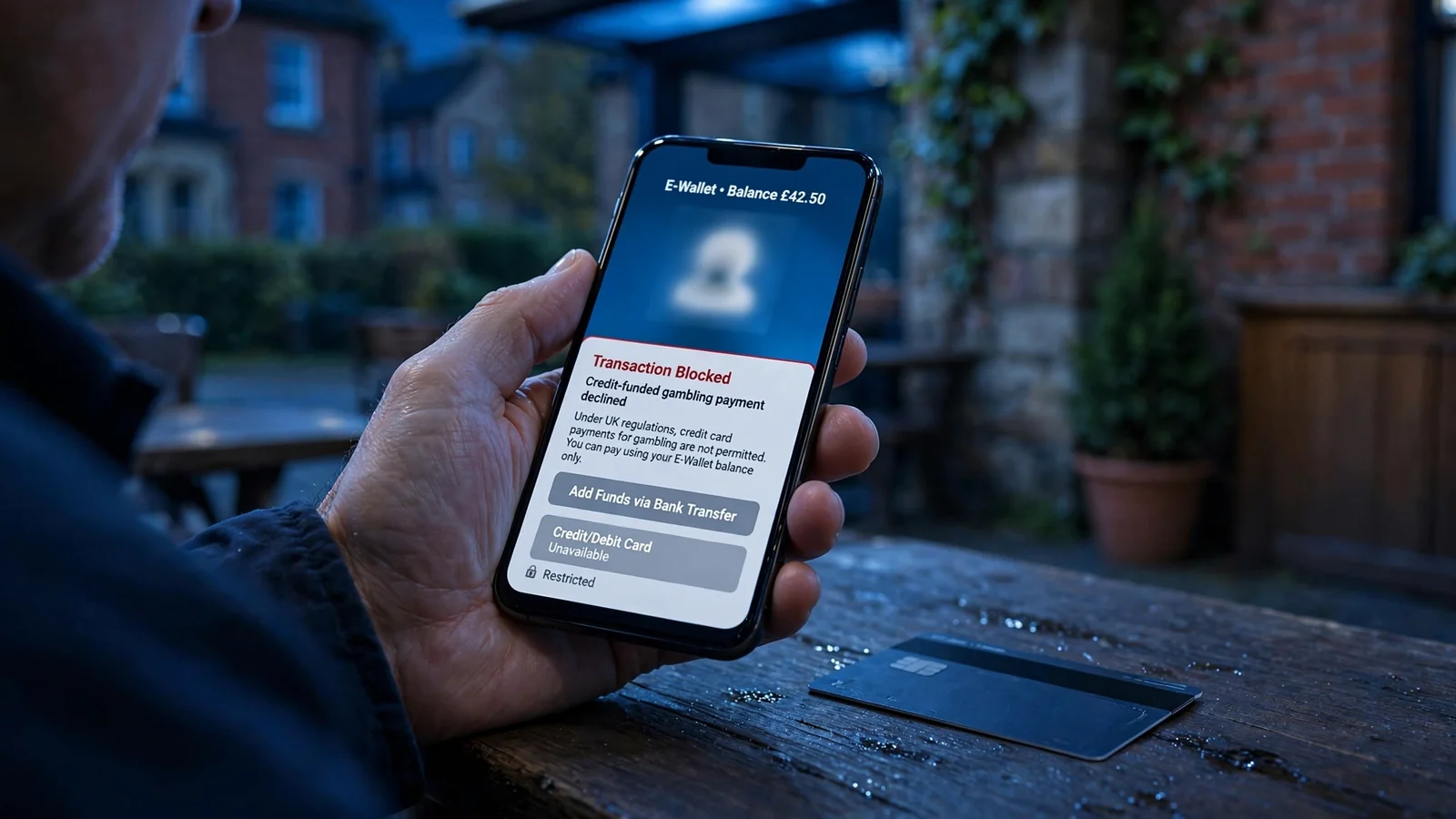
The relevant conditions are therefore account-specific and transaction-specific. A wallet may support gambling payments while still requiring controls that block credit-funded activity. The casino’s cashier may list a method, but the listing is not a substitute for the operator’s obligation to ensure that the payment route complies with the credit-card prohibition.
For withdrawals, the question changes from whether credit is being used to whether the operator can return funds to the correct customer. A withdrawal may be directed back through an approved payment method or handled under the operator’s stated terms, but the destination must remain consistent with identity, ownership and anti-money-laundering controls. A mismatch between the casino account and the payment account can require additional checks before funds are released.
KYC before funds are released
UK operators must implement know-your-customer policies, commonly referred to as KYC. These controls establish who holds the account and whether the customer is entitled to use the payment method connected to it. They operate alongside anti-money-laundering and counter-terrorist-financing procedures.
Identity and ownership are central to the UKGC’s licensing assessment. In practice, an operator may need to verify personal details, confirm ownership or control of a payment method, and examine information relevant to the source of funds. The exact documents and checks depend on the account and the risk assessment. The governing principle is fixed: the operator must not process gambling activity without adequate customer information.
KYC can affect both deposits and withdrawals. An account may accept an initial payment and later be placed under review when a withdrawal is requested or when transaction activity triggers a compliance check. That is not a separate withdrawal tax. It is a verification stage connected with the operator’s duties.
A request for documents should therefore be assessed against the purpose of the check. The operator may be confirming identity, payment ownership, address, source of funds or another element of its AML/CTF procedure. The account terms should explain the relevant process and complaint route. If a dispute remains unresolved, complaint handling procedures must be available under the operator’s compliance framework.
Verification Checklist
- Identify the legal operator in the terms and conditions
- Match the operator name against the UKGC public register
- Confirm the domain corresponds to the licence holder
- Ensure the payment method is not credit-funded
No gambling tax is charged to UK customers on winnings. Gambling winnings are tax-free in the UK regardless of the amount won. That tax treatment does not remove KYC requirements and does not convert a withdrawal into an unconditional payment. Tax-free winnings and verified withdrawals are separate issues: one concerns the customer’s tax position, while the other concerns the operator’s legal and financial controls.
Player funds and the right to withdraw
Players must be able to stop playing at any time and retain the remaining deposit and winnings earned from that deposit. This rule is important because it distinguishes a withdrawal request from a bonus condition or a game-selection issue. Funds that belong to the customer cannot be made unavailable merely because the customer has chosen to stop gambling.
The operator must still complete required checks before releasing money. A withdrawal can be reviewed for identity, payment ownership, AML/CTF concerns or other compliance reasons. Those checks do not cancel the underlying requirement to preserve the customer’s remaining deposit and eligible winnings. They determine whether and how the payment can be processed lawfully.
Operators must also maintain data-protection rules and terms of use. The payment section of the terms should identify available methods, account restrictions, verification requirements and the procedure for raising a complaint. The wording matters because a cashier label may be brief, while the legal conditions governing deposits and withdrawals are contained elsewhere in the operator’s documentation.
What the payment record shows
A compliant payment history should make the movement of money traceable. Deposits need an identifiable source, withdrawals need an identifiable recipient, and account activity must be capable of review under KYC and AML/CTF procedures. That is why payment ownership is not a cosmetic detail. A method registered to another person can create a compliance issue even where the transaction itself appears technically successful.
The UKGC’s enforcement powers include warnings, licence conditions, suspensions, revocations and financial penalties. These powers explain why payment controls are treated as an operating obligation rather than a customer-service preference. Failures in anti-money-laundering procedures, social responsibility or player protection can affect the licence itself.

For customers, the financial calculation is direct. Credit-funded gambling is excluded from the permitted payment structure; e-wallet use depends on controls that block credit-card funding; KYC can delay release while identity and source-of-funds questions are examined; and winnings remain tax-free in the UK. The cashier may look like a simple transfer screen, but the legal transaction is controlled at every stage.
Bonuses and Promotions Under UK Gambling Rules
Bonuses and promotions at online casinos serving Great Britain operate within the UKGC compliance framework. The commercial offer may contain free spins, matched deposits, cashback or other incentives, but the promotion is not separate from the operator’s regulatory duties. The licence remains the controlling condition: operators providing remote gambling to consumers in Great Britain must hold the relevant UKGC licence, and the same licence framework applies when promotional activity is used to attract or retain customers.
The practical distinction is important. A bonus describes the commercial terms attached to an offer. Responsible-gambling controls determine how gambling activity is funded, paused, monitored or stopped. A promotion cannot override those controls. A deposit limit remains effective after a bonus is accepted; a timeout must interrupt play even when promotional funds remain; self-exclusion removes access to the gambling service rather than preserving access for the purpose of completing an offer.
What a promotion must be assessed against
The value of a casino promotion is not the headline amount alone. Its financial effect depends on the conditions attached to acceptance and use. Relevant conditions can include the qualifying deposit, the games or transactions that count, the treatment of winnings, the expiry position and the circumstances in which the offer can be removed. If any condition changes the amount that can ultimately be withdrawn, it is part of the economic calculation.
That calculation should be kept separate from the player’s own deposited funds. Players must be able to stop playing at any time and retain their remaining deposit and winnings earned from that deposit. A promotional balance does not convert those rights into a requirement to continue gambling. The existence of an incentive therefore does not justify withholding a player’s qualifying balance when gambling is stopped under the applicable rules.
Tax Status
Gambling winnings are tax-free in the UK, regardless of the amount won.
The promotion also sits under the wider advertising and consumer-protection obligations applied to licensed operators. The UKGC’s public register records regulatory actions, including licence conditions, fines, warnings and revocations. Those records matter because promotional compliance is not assessed only at the point at which an advert appears. Failures in the wider operation can affect the regulatory position of the licence itself.
Deposit limits come before the offer
Operators must prompt players to set a deposit limit before their first deposit. This requirement places a control at the funding stage, before a promotional balance can encourage further play. A bonus can therefore affect the attractiveness of a deposit, but it does not remove the need for a deposit limit or postpone the prompt until after the first transaction.
A deposit limit is not the same as a promotional budget. The promotion governs an incentive offered by the operator; the deposit limit governs the amount placed into the gambling account. Treating the two as interchangeable would distort the actual exposure. A player may receive a promotional credit, but the account still requires a deposit-limit setting before the first deposit.
Remote operators must also check customers with net deposits of £150 or more per month from 28 February 2025. This is a compliance check connected with customer activity, not a promotional entitlement. It should not be described as a bonus threshold or as a condition that unlocks an offer. The distinction is financial rather than cosmetic: a promotion changes the commercial terms of play, while the net-deposit check addresses the operator’s assessment duties.
Timeouts and reality checks
The UKGC framework requires operators to provide time limits, including session time limits and timeouts, as well as reality checks. These controls address the duration and visibility of gambling activity rather than the value of an offer.
A timeout is a break from gambling. Its function is incompatible with designing a promotion around uninterrupted play. If a timeout is activated, the promotional balance does not create a contractual reason to keep the account active for gambling purposes. The relevant result is that play stops for the timeout period under the operator’s terms.

Reality checks serve a different accounting function. They interrupt or flag the session so that the duration of play is made visible. This is useful where a promotion encourages repeated activity, because the headline value of the offer says nothing about the time spent pursuing it. Session duration, deposits and remaining funds are separate measures; combining them into one promotional figure produces a poor record of cost.
Self-exclusion and GamStop
Operators must connect to a nationwide database of self-excluded users and enforce strict age control. All remote operators must be members of GamStop, the national online self-exclusion scheme. Operators must also provide self-exclusion for a minimum of six months.
Self-exclusion takes priority over promotional participation. Once the relevant exclusion control applies, the commercial value of an unused bonus is not a reason to continue gambling or to reopen access. A promotion cannot be used to bypass GamStop, shorten the minimum self-exclusion period or preserve gambling access under a different marketing route.
The age requirement is equally direct. The general legal gambling age in the UK is 18, and strict age control is required. Promotional advertising and account incentives do not create an exception. A person below the legal gambling age cannot make a lawful casino promotion simply by satisfying the offer’s commercial conditions.
Licence checks and promotional accountability
A casino’s licence position can be checked through the UKGC public register. The relevant process is to match the operator name or licence number with the register and confirm that the listed domain is the domain offering the promotion. This matters because a familiar brand name does not, by itself, establish that a particular website is the licensed operation.
The register also provides a record of recent regulatory action. The UKGC can impose licence conditions, issue warnings, apply financial penalties, suspend or revoke licences, and investigate illegal gambling. Promotional activity should therefore be viewed as part of the operator’s accountable business, not as an isolated marketing layer with no regulatory consequence.
Controls the amount of money placed into the gambling account before play begins.
Provides a mandatory break from gambling by interrupting access for a selected period.
Interrupts or flags a session to make the duration of play visible to the user.
Enforced via GamStop to stop all access to gambling services for a minimum of six months.
The practical financial rule is simple: calculate the offer from its stated conditions, then apply the responsible-gambling controls independently. Deposit limits govern funding; timeouts govern interruption; reality checks expose session duration; self-exclusion and GamStop stop access. None of these controls disappears because a bonus is pending. That is the boundary between a promotion and permission to gamble.
Casino Games and Slots: What the Software Layer Determines
Casino games are the visible output of a regulated software system. The reels, cards, roulette wheel, bonus rounds and live interfaces are the parts players see, but the underlying software determines how those products operate: how outcomes are generated, how rules are displayed, how sessions are recorded and how the operator can demonstrate compliance.
For UK players, the relevant market is Great Britain, where remote gambling is regulated by the UK Gambling Commission. That framework affects the games category directly. It is not limited to the operator’s licence page or account controls. The casino content itself must function within the technical and responsible-gambling requirements applying to remote gambling.
What the software controls
A digital casino game is not merely a graphic interface. Its software controls the outcome process, the presentation of rules and the recording of activity. In a slots game, that includes the reel sequence, winning combinations, feature triggers and the result shown after each spin. In roulette, it includes the process producing the winning number and the way bets are matched to the result. In live casino, the software connects the streamed event with the betting interface and account record.
This distinction matters because visual quality says little about financial behaviour. A polished game may still have rules that require close examination. The important information is the game’s own explanation of its mechanics, including the available stake options, winning conditions and any feature restrictions. If a feature is conditional, the condition is part of the product rather than decorative text.
The software layer also determines how quickly a player can move between games, repeat a stake or activate an in-game feature. Those design choices affect the pace of play. A fast interface can produce more decisions in the same session than a slower one, even when the individual game rules remain unchanged. For that reason, game design and player-protection controls cannot be treated as entirely separate subjects.

Slots and the £5 spin limit
Online slots are subject to a £5 per spin limit from 9 April 2025 for players aged 25 and over. This is a direct example of regulation changing the player-facing product. The limit applies to the spin itself, so a slot interface must prevent a qualifying player from selecting a stake above the permitted amount.
The rule does not make every slot financially identical. A spin can still produce different outcomes, feature patterns and losses. It also does not remove the need to read the game rules. The permitted stake is one condition; the game’s outcome structure is another. Treating the maximum stake as a measure of value would be a basic accounting error.
The age distinction is also operational. The software and account system must identify the relevant player category before applying the applicable limit. That is one reason age controls are part of the remote-gambling environment rather than a separate administrative formality.
Game categories and decision points
Casino menus generally divide content into recognisable categories: slots, roulette, blackjack, baccarat, table games and live casino. Those labels help classify the product, but they do not replace the rules for an individual game.
Game Information Layers
Digital casino games include several critical layers of information beyond the graphics:
- Available stake options and limits
- Specific rules for winning combinations and features
- Side bet mechanics and conditions
- Session recording and result displays
Slots tend to place the largest amount of information inside the game interface. Paylines or winning patterns, symbols, feature conditions and stake controls are presented through menus or information panels. Table games usually make the main rules more visible, but side bets and optional features can change the economics of a round. Live products add a streamed table, a dealer interface and betting cut-off mechanics.
The common point is that each category contains its own conditions. A game title does not establish the odds, the available stakes or the treatment of a feature. Nor does the presence of a familiar format prove that every version behaves in the same way. Software determines the actual version being offered.
A practical assessment therefore starts with the game information rather than its artwork:
- the available stake controls;
- the rules for winning outcomes;
- the conditions attached to features or side bets;
- the way the session displays results and account activity;
- the responsible-gambling controls available while the game is open.
No unsupported catalogue of named games is required to understand this layer. The meaningful question is how the individual product operates within the regulated casino environment.
Technical standards and responsible play
The UKGC’s Remote Gambling and Software Technical Standards, known as RTS, form part of the technical framework for remote gambling software. The LCCP also sets licence conditions and codes of practice for operators. Together, these frameworks connect the game interface with wider operational duties.
This connection is visible in practical controls. Remote operators must provide deposit limits, loss limits, session time limits, reality checks, self-exclusion and timeouts. A game interface does not exist outside those controls. Depending on the operator’s design, a player may see account information, elapsed-session prompts or links to responsible-gambling settings while using casino content.
All remote operators must be members of GamStop, and operators must connect to a nationwide database of self-excluded users. Self-exclusion therefore affects access to the casino games layer, not merely promotional communication. If the account is covered by a valid self-exclusion arrangement, the player should not be able to continue gambling through the operator covered by that arrangement.
The minimum self-exclusion period is six months. A timeout is a different control: it interrupts access for a selected period without being the same as formal self-exclusion. A deposit limit controls money entering the account, while a loss limit addresses the financial result. These controls measure different things, and the software must present them as separate mechanisms rather than one generic safety label.
Why compliance history matters to games
The game screen cannot be assessed independently from the operator running it. A casino may display attractive content, but the operator remains responsible for compliance, player protection and the controls surrounding that content. Regulatory enforcement shows why the distinction matters.

The UKGC fined William Hill £6.2 million in February 2018 for failures to protect players and prevent money laundering. The issue was not the appearance of a particular slot or table game; it concerned the operator’s wider safeguards. That wider record is relevant because the same account environment governs access to casino content.
In June 2018, 32Red was fined £2 million for failing a problem gambler. In May 2018, LeoVegas was fined £600,000 for misleading adverts and self-exclusion failings. These cases show that compliance problems can arise in the relationship between marketing, account management and gambling access. Game quality does not offset failures in those areas. A sophisticated interface remains a weak product if the operator does not apply its obligations consistently.
The useful separation is therefore clear. Games determine the immediate rules and mechanics of play. The operator’s regulatory systems determine whether access, limits, self-exclusion and player protection are handled lawfully around those games. Both layers affect the actual gambling experience.
Reading a game as a financial product
A casino game should be treated as a defined financial activity, not as entertainment without conditions. Each spin, hand or wager transfers money according to rules encoded in software. The relevant calculation is not whether the design looks modern, but what stake is selected, what outcome rules apply and how long the session continues.
That approach also prevents unsupported assumptions. A game should not be described as safer, fairer or more profitable without verified evidence. A familiar title does not guarantee a particular result, and a feature animation does not change the underlying account balance. The software determines the transaction; the account records the consequence.
Within the UK market, regulated operation adds a further layer of accountability. The UKGC licence framework, RTS, LCCP, GamStop participation and mandatory player controls surround the content. The result is a games category shaped by both software mechanics and compliance requirements. The reels and tables are only the visible part of the calculation.
Regulated Market Great Britain
Primary Regulator UK Gambling Commission (UKGC)
Key Legislation Gambling Act 2005
Mandatory Self-Exclusion GamStop
Game Providers and Casino Software: How the Technology Is Supplied
Casino software is the operating layer behind every remote gambling product. It connects the operator’s website with game content, account controls, transaction records and compliance systems. The provider may supply the technical platform, individual games, or both, while the licensed operator remains responsible for how the service is offered to customers in Great Britain.
That division matters. A familiar software brand does not replace the operator’s UKGC obligations, and an operator’s licence does not turn every technical supplier into a regulated casino. The commercial arrangement can be invisible on the front end, but it determines who controls the software, who receives operational data and who must correct a failure.
Operator responsibility remains central
For remote gambling in Great Britain, the operator serving the customer must hold the relevant UKGC licence. The provider layer therefore sits inside a controlled chain rather than outside regulation. Software, hosting, game integration and customer-facing account functions must operate consistently with the conditions attached to the licensed service.
The practical test is not simply whether a game loads. A compliant operation must also preserve the controls surrounding it. These include identity and age checks, responsible-gambling procedures, data protection, complaint handling and anti-money-laundering requirements. The operator must also connect to GamStop and enforce the applicable self-exclusion controls.
This creates two different accountability questions:
- Who supplies the technology? This concerns the platform, game content, integration and technical maintenance.
- Who offers gambling to the customer? This is the licensed operator, which carries responsibility for the remote gambling service.
A provider can deliver a technically stable product while the operator fails in social responsibility or anti-money-laundering controls. Conversely, an operator can have a valid licence while its technical implementation creates inaccurate records or weak access controls. In both cases, the customer experiences one service, but the compliance analysis must separate the participants.
What the software layer controls
Casino software can determine how a product is presented and administered, even when the underlying game content comes from another company. Important functions include account access, game launch, bet recording, balance updates, session information and the transmission of data to the operator.
The compliance value of these functions is straightforward: a gambling transaction must be recorded accurately, linked to the correct account and handled within the operator’s control framework. If the software cannot apply a restriction, record a limit or preserve an audit trail, the issue is not cosmetic. It affects whether the operator can demonstrate that its obligations were followed.

The same applies to changes in the software environment. A new integration, revised interface or substituted content source can alter the way controls operate. The operator therefore needs oversight of suppliers rather than treating technology as a sealed product purchased once and left alone. Supplier management is part of operational accountability.
Technical standards also matter. The UKGC’s Remote Gambling and Software Technical Standards, known as RTS, form part of the professional vocabulary used when assessing remote gambling technology. The relevant question is not whether a platform looks modern. It is whether the system supports the technical and regulatory conditions under which the licensed service is supplied.
Provider accountability is not a marketing label
Terms such as “trusted provider” have little analytical value without a defined responsibility behind them. A provider’s commercial reputation may indicate experience, but it does not prove that a specific operator’s implementation is compliant. The enforceable relationship remains connected to the licensed operator and the conditions imposed on that operation.
The LCCP is the central reference point for licence conditions and codes of practice. It frames the obligations that operators must meet and helps explain why provider due diligence matters. A supplier may not be the entity named on the customer’s gambling account, yet its systems can affect the operator’s ability to comply with the LCCP.
The financial consequences of weak oversight are not theoretical. Ladbrokes Coral agreed to pay £5.9 million in July 2019 after anti-money-laundering and social-responsibility failings. The case concerned operator duties, but it illustrates the commercial outcome when controls around a gambling service do not work. Technology cannot be assessed separately from the governance built around it.
The UKGC also fined Camelot Group £3 million in December 2016 for failing to verify a fraudulent National Lottery ticket. That was not an online casino software case, but it demonstrates the wider principle: a gambling system can fail at the point where information, verification and operational decisions meet. A provider arrangement is only as strong as the controls that govern those decisions.
Is the software provider responsible for my licence?
No, the licensed operator remains responsible for the gambling service, even if the software is supplied by a third party.
Does a brand name guarantee a licence?
No, a brand name is not a substitute for checking the operator’s name and domain against the UKGC public register.
What happens if an operator fails compliance?
The UKGC can issue warnings, impose financial penalties, suspend, or revoke the operating licence.
Regulatory action shows where risk accumulates
Regulatory enforcement can involve financial penalties, warnings, licence conditions, suspensions or revocation. Each measure affects the commercial environment in which casino software is supplied. A suspension can interrupt the operator’s ability to provide gambling; a revocation removes the legal basis for the service.
Genesis Global Limited’s licence was suspended and the company was fined £3.8 million for social-responsibility and anti-money-laundering failings. The material lesson for software supply is limited but important: customer-protection controls cannot be treated as an optional layer added after the platform is operational.
The Gambling Commission also revoked Silverbond Enterprises’ operating licence over concerns about the source of funds and future profits, as reported by standard.co.uk. That outcome concerns the operator’s financial position rather than a named software supplier. It nevertheless shows why ownership, funding and business viability form part of the regulatory assessment around a gambling service.
A specialist industry overview attributes a £19.2 million settlement in 2023 to William Hill Group and describes it as the UKGC’s record settlement. That statement is source-specific, not a general market rule. The figure does not establish a standard penalty for software failures; it shows that regulatory exposure can become financially material when broader operational duties fail.

Two licences, those of BresBet Ltd and Bet St George Ltd, were suspended on 28 August 2026. The event reinforces the same distinction: the existence of a software relationship does not preserve an operator’s authority once regulatory action affects its licence.
Assessing the supply chain
A sensible assessment of casino software starts with the licensed operator, not the provider logo. The operator name, licence number and listed domain can be checked against the UKGC public register. The register also records regulatory actions, including conditions, fines, warnings and revocations.
The next question is whether the operator clearly controls the service it offers. Terms should identify the contracting operator, and the account, support and complaint routes should correspond with that entity. A provider name in a game window is not a substitute for this information.
The final question is operational: can the service apply the controls required of a UK-facing remote gambling business? That includes age control, GamStop participation, deposit and loss controls, timeouts, reality checks, self-exclusion and the retention of remaining funds when play stops. These are operator-facing duties, but the software may be the mechanism that applies them.
A casino platform is therefore not just a collection of games. It is infrastructure carrying financial records, customer restrictions and regulatory evidence. The provider supplies part of that infrastructure; the licensed operator remains accountable for the service that reaches Great Britain. That is the calculation that matters: technical branding may change, but regulatory responsibility does not.
Prepared by the Casinouk Licensing Info editorial staff.